AI Will Not Replace Your Marketing Team. But It Will Change How You Manage It.
AI Will Not Replace Your Marketing Team. But It Will Change How You Manage It.
Why marketers must learn how to brief, supervise and develop their automated interns
Most marketing teams have experienced the enthusiastic intern.
They arrive with energy, ideas and a genuine desire to help. They can research competitors, draft social posts, organise spreadsheets and sometimes surprise everyone with a genuinely brilliant suggestion.
They can also misunderstand the brief, use the wrong information, miss an important piece of context or create something that should never reach a customer.
Artificial Intelligence is the automated version of that intern, operating at extraordinary speed and scale.
It can research, write, summarise, analyse, brainstorm, edit, translate and repurpose content. It can help a small marketing team produce the volume of work that previously required a much larger department.
However, it still needs managing.
This is why I believe we may be the last generation of managers to lead only humans. Marketing managers are already becoming responsible for mixed teams containing employees, freelancers, software, automated workflows and AI agents.
On Monday 31 August at 5:30pm BST, I’ll be joining Jo Dodds on the Engage for Success Radio Podcast to discuss what happens when our teams are no longer entirely human.
The conversation is called Did You Know We Are the Last Generation to Manage Only Humans?
Although the podcast covers leadership and the future of work more broadly, the implications for marketing teams are enormous.
Your Marketing Team Already Has an Invisible AI Workforce
AI adoption is moving faster than most formal organisational strategies.
The Office for National Statistics reports that AI use among UK businesses with ten or more employees has increased from approximately 12% in late 2023 to around 35% in 2026.
However, adoption remains relatively shallow. Businesses using AI employ only 1.6 different AI technologies on average, suggesting that many organisations have given people access to AI without fully integrating it into their workflows.
Employees are not necessarily waiting for a formal strategy.
They are using AI to draft emails, create presentations, summarise documents, research customers and generate content. Some of this work is being completed through approved corporate platforms. Some is happening through personal accounts that managers cannot see.
Marketing departments are particularly exposed because their work involves large amounts of writing, research, data, imagery and repetitive production. These are precisely the areas where generative AI appears most immediately useful.
Your AI marketing workforce may already exist. The question is whether anyone is managing it.
The Marketing Problem Is No Longer a Lack of Content
For years, marketing teams have been told to create more.
More blogs. More videos. More emails. More social posts. More personalised campaigns for more platforms, audiences and stages of the customer journey.
AI makes that volume possible, but it also creates a new problem.
If every organisation can generate hundreds of competent articles, images and social posts, content itself becomes less valuable. The internet fills with material that is technically correct, professionally presented and almost completely forgettable.
AI can help marketers produce more mediocrity at greater speed.
The differentiator will not be the ability to create content. It will be the ability to create something useful, distinctive and trusted.
That still requires human understanding. A good marketer knows the customer’s anxieties, the organisation’s commercial priorities, the history behind the brand and the uncomfortable truth that nobody has written in the official brief.
AI can help express an idea. It cannot decide whether the idea deserves anybody’s attention.
Where Automated Interns Can Help a Marketing Team
The strongest marketing teams will not reject AI or allow it to operate without supervision. They will allocate the right work to the right combination of humans and machines.
Research and Customer Insight
AI can help marketers organise customer feedback, identify recurring themes, compare competitor messaging and summarise large amounts of research. This gives human marketers more time to investigate what those patterns mean and decide which insights are commercially important.
However, AI-generated research must be verified. A confident summary is not necessarily an accurate one, particularly when the source material is unclear or incomplete.
First Drafts and Content Development
AI is extremely useful for creating initial structures, generating alternative headlines and turning notes into a working first draft. It removes some of the friction that prevents people from starting.
The human marketer must still supply the original argument, lived experience and meaningful point of view. Without these, the automated intern simply rearranges familiar information into another generic article.
Content Repurposing
A strong keynote, webinar, podcast or research report can become a series of blogs, emails, videos and social posts. AI can help adapt the core material for different formats and audiences without requiring the marketing team to start again each time.
The key word is “adapt”. Copying the same content everywhere creates duplication and ignores why people use different channels.
Campaign Analysis
AI can examine campaign results, compare performance and identify patterns that a busy marketer might miss. It can help teams ask better questions about which subjects, audiences and formats produce the strongest response.
Yet data does not interpret itself. A strong result may have been caused by timing, context or an unusual external event rather than the content alone. Human judgement is needed before a correlation becomes a strategy.
Marketing Administration
Meeting summaries, action lists, content calendars, formatting and routine reporting can consume hours of a marketing team’s time. These are excellent tasks for an automated intern because they can be structured, checked and repeated.
The objective should not simply be to complete more administration. It should be to return time to people so they can undertake more valuable work.
What AI Should Not Own
AI can support almost every part of marketing, but support is not the same as ownership.
It should not independently decide the organisation’s strategy, make unverified factual claims or publish sensitive material without approval. It should not determine the ethical boundaries of a campaign or make promises the organisation cannot keep.
AI also cannot own accountability.
If an automated system publishes inaccurate information, invents a customer testimonial or uses confidential data improperly, the organisation remains responsible. Saying “the AI created it” will not protect the brand or restore customer trust.
This is why every significant AI marketing workflow requires a named human owner. That person must understand what the system does, which information it can access and how its work will be checked.
Five Management Rules for Your AI Marketing Team
Marketing leaders do not need a hundred-page strategy before they begin. They do need clear working practices.
1. Start With the Marketing Objective
Do not begin with the tool. Begin with the result you want.
Are you trying to understand customers, generate qualified leads, improve retention or save time on repetitive production? The objective determines whether AI is appropriate and how its contribution should be measured.
2. Give the Automated Intern a Proper Brief
Explain the audience, business objective, brand voice, evidence, required format and boundaries. Include examples of strong work and clarify what the system must avoid.
If the brief would confuse a new employee, it will probably confuse the AI as well.
3. Protect Customer and Organisational Data
Marketing teams handle customer information, commercial plans, campaign performance and unpublished material. Leaders must establish which data can be processed through each system and which must remain protected.
This cannot be left to individual judgement alone. People need simple rules and approved tools.
4. Keep Human Approval Visible
Important customer-facing work should have a clear review process. This is particularly important for factual claims, pricing, regulated sectors and sensitive topics.
The human reviewer should do more than correct grammar. They must assess accuracy, relevance, empathy and whether the work genuinely sounds like the organisation.
5. Measure Value, Not Volume
Producing five times more content is not a success if nobody reads, trusts or responds to it.
Measure the commercial outcome, the time saved and the improvement in quality. If AI creates more work for reviewers or fills channels with weak content, the process needs redesigning.
Shadow AI Is Also a Marketing Leadership Warning
When employees secretly use AI, organisations often respond with tighter policies and additional restrictions.
Sometimes those controls are necessary. However, hidden AI use can also indicate that employees do not trust the official process or believe the approved tools meet their needs.
Personio’s Workforce Pulse research found that only 36% of employees believe their employer provides adequate AI training or support, while 44% want more help.
Marketing employees are expected to produce more while adapting to rapidly changing platforms and customer behaviour. If leaders do not provide useful training, people will teach themselves.
The stronger response is to combine sensible governance with practical AI marketing training. Give people safe spaces to experiment, share useful applications and discuss where the technology has failed.
Responsible AI adoption grows through transparency, not silence.
There is an optimistic side to this transformation.
If AI takes away repetitive production, marketers can spend more time speaking to customers, developing original ideas, building relationships and understanding what people genuinely need.
It can give smaller organisations access to capabilities that were previously expensive or unavailable. A small team can analyse research, test creative directions and produce high-quality campaigns without needing a huge budget.
The danger is that organisations use the saved time only to demand greater volume.
If AI helps someone complete five hours of work in one hour, adding another five hours of automated production is not necessarily progress. Leaders should decide how that saved time can improve creativity, customer experience, learning or wellbeing.
The purpose of AI should not be to make marketing less human. It should be to remove some of the mechanical work that prevents marketers from being human.
The Future Marketing Manager Will Manage Humans and AI
Tomorrow’s marketing manager will allocate work across a mixed team.
A human may define the strategy, conduct the customer interview and identify the central insight. An automated intern may analyse the transcript, organise the findings and produce an initial content structure. The human may then add experience, judgement and emotion before another AI system creates different formats for each channel.
This is not humans versus machines. It is intelligent collaboration.
However, collaboration only works when roles, standards and accountability are clear. Without management, AI creates greater output but not necessarily greater value.
This is part of the wider leadership transition explored in The Fifth Industrial Revolution. Artificial Intelligence provides speed and scale, but organisations also need Emotional Intelligence, Independent Intelligence and Organisational Intelligence to use it well.
As Dan Sodergren explains in his main article, the future will increasingly belong to leaders who can manage humans and AI rather than those who can manage only humans.
Marketing will be one of the first places where that difference becomes visible.
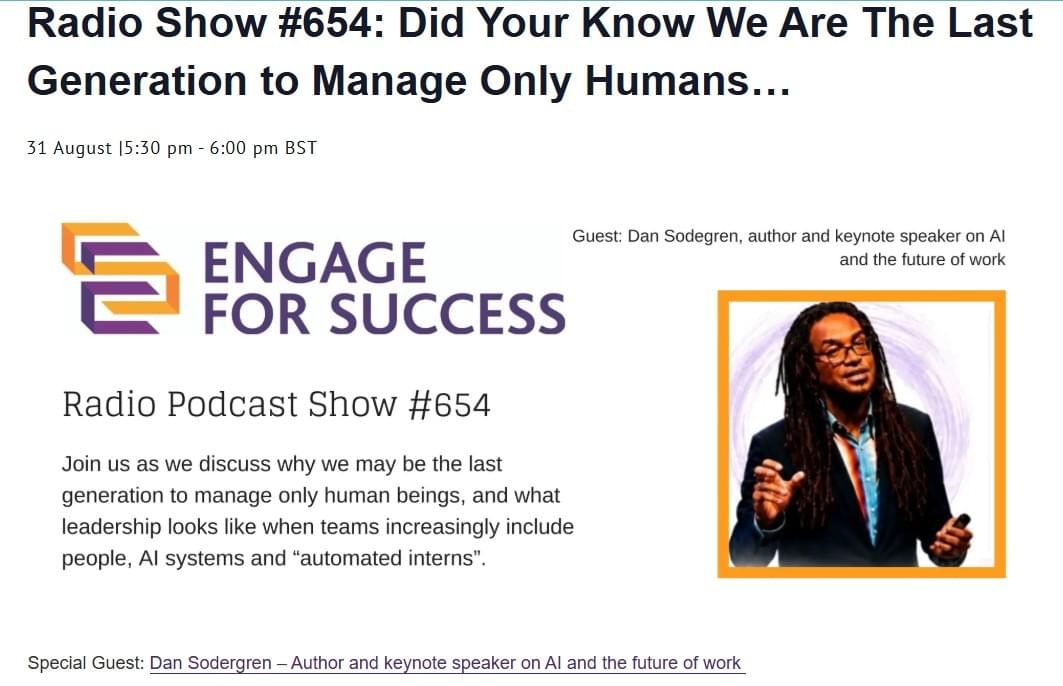
Join Jo Dodds and Dan Sodergren on the Engage for Success Radio Podcast as they discuss AI, employee engagement, automated interns and the future of management.
Monday 31 August 2026
5:30pm BST
About Dan Sodergren and Great Marketing Works
Great Marketing Works has trained organisations in marketing, digital technology and social media for more than 15 years. Its work now includes practical AI marketing training that helps teams save time, improve their output and use Artificial Intelligence responsibly.
Founder Dan Sodergren is an AI transformation strategist, technology expert and keynote speaker specialising in AI, marketing and the future of work.
Learn more about booking Dan as an AI and future-of-work keynote speaker, explore his work as an AI expert, or discover the AI Marketing Course.